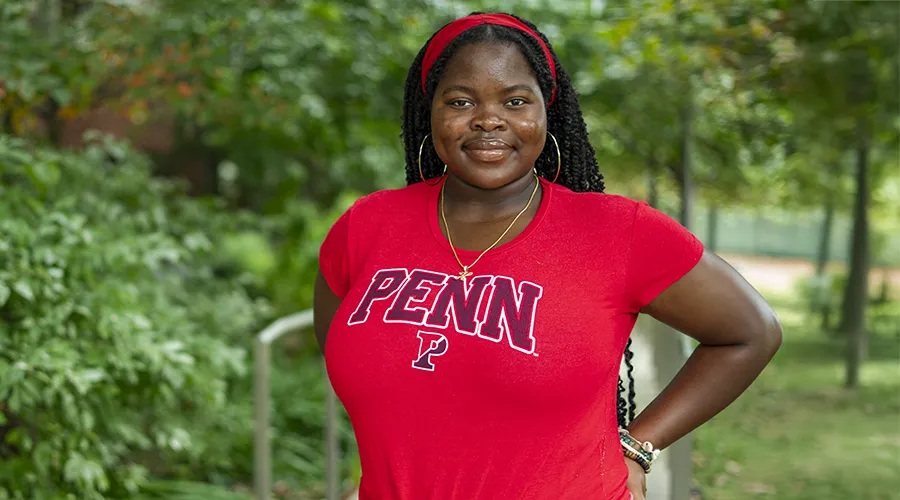
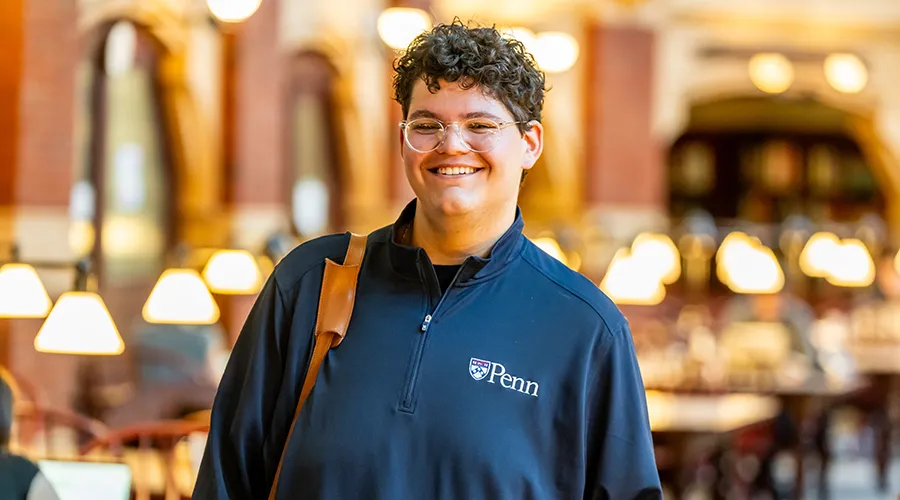
At Penn, providing access and opportunity for talented undergraduate students like Lindsay is fundamental to who we are.

Our Unwavering Commitment
Penn strengthens its long-standing commitment to undergraduate financial aid with expanded support for middle-income families
Spring 2025

Meet
Lindsay, C’28
College of Arts & Sciences
Lindsay’s journey to Locust Walk began when her high school teacher recommended a Penn summer program focused on biomedical research. “I fell in love with the campus and the program,” Lindsay explains. “I quickly realized that if I wanted to reach high and stay close to home, Penn was the best place.”
But financial aid was a major consideration for Lindsay, a Philadelphia resident. Fortunately, she was accepted to Penn, and thanks to the Quaker Commitment, she received a financial aid package that covered tuition and costs, making it possible for her to enroll.
As a first-generation college student, Lindsay has found a welcome home in the Penn First Plus (P1P) program, which serves students who are the first in their families to attend college and/or those from modest-income backgrounds. “I liked the community they built, the resources, and the people,” she says. She is especially grateful to her P1P student mentor, who helped her successfully navigate her first year.
Next year, Lindsay hopes to give back by serving as a mentor for the newest class of P1P students. At the same time, she’ll continue her studies, with an eye toward a possible Health and Societies major and a career as a dentist.
“Higher education is one of America’s greatest strengths. It is a long-standing social contract that has enabled U.S. colleges and universities to be a cornerstone of innovation and opportunity in our society,” explains Penn President J. Larry Jameson.
Too often, however, financial constraints—not ability, ambition, or potential—determine who has a seat at the table. That is why Penn has led the charge to ensure that talented students admitted to Penn can afford to attend. And while they’re here, they can study, research, create, and fully engage in the Penn experience.
“At Penn, we are deeply committed to ensuring that this pathway to personal opportunity and societal impact remains affordable for all talented students,” President Jameson continues. “Financial aid has always been critical to our ability to keep this pathway open and available for the next generation—undergraduates, as well as graduate and professional students. With federal funding at risk, this priority has never been more important.”
The Quaker Commitment:
Our Promise
- 🛡️ 100% of demonstrated need met with grant-based, no-loan financial aid packages
- 🛡️ Home equity will not affect financial aid calculations
- 🛡️ Expanded support for middle-income families ($75,000–$200,000), including scholarships guaranteed to cover at least full tuition
- 🛡️ Comprehensive support for highly aided students (under $75,000), covering tuition and fees, housing, and dining, as well as additional resources to ensure access to the full Penn experience
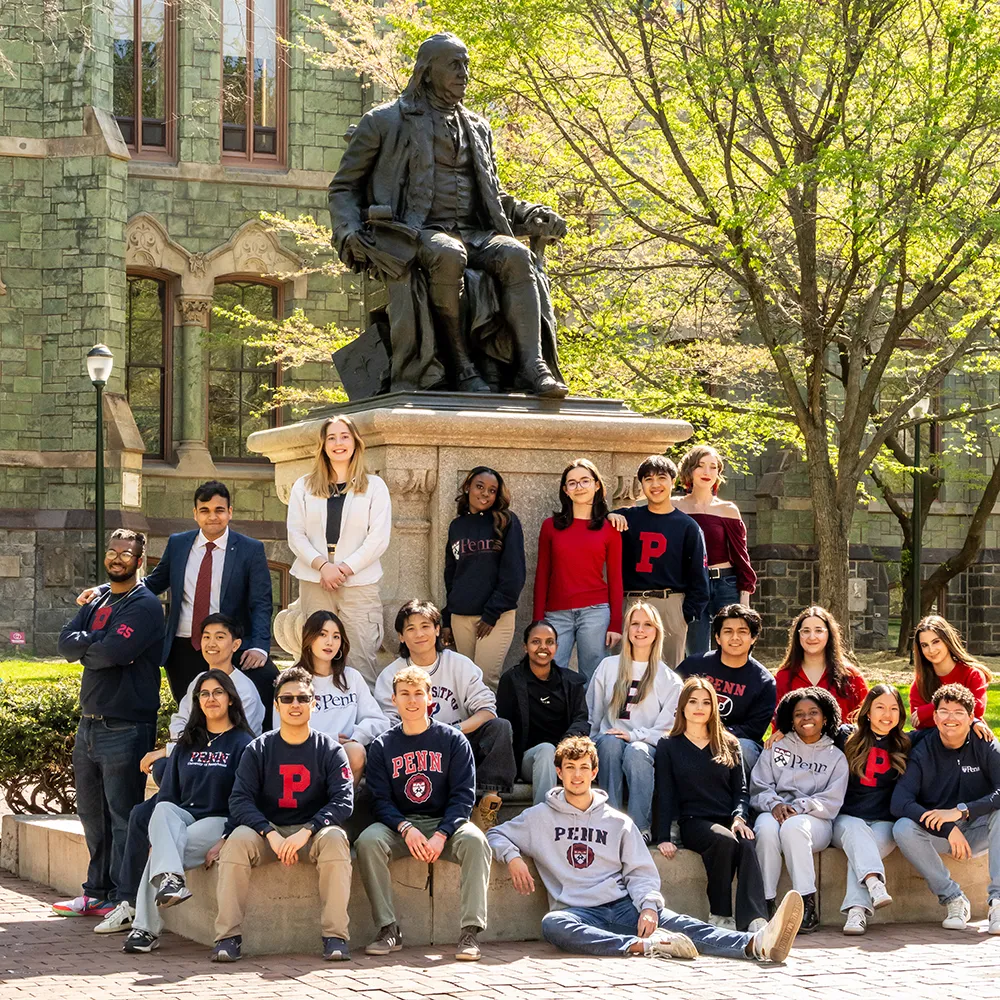
Making Penn More Affordable and Accessible than Ever Before
Penn has a long-standing commitment to providing grant-based undergraduate financial aid that meets 100 percent of a student’s demonstrated need without loans. Last fall, the University built upon that commitment with expanded policies that help middle-income families.
With this change, already effective for all aided students, Penn will be tuition-free for students from families earning $200,000 or less. The higher income threshold also closes an “opportunity gap” that previously excluded middle-income families. In addition, the University will no longer consider the value of the primary family home in determining financial aid eligibility.
Together, these changes to the Quaker Commitment will have a meaningful impact on families, with the average aided student seeing an increase of $5,000 in support per year.
This latest expansion builds upon nearly 20 years of growth in Penn’s undergraduate financial aid program, beginning in 2008, when Penn announced that it would replace loans with grants in its financial aid packages so students would not be burdened with significant debt upon graduation. The first among its Ivy League peers to adopt an all-grant policy, Penn has been a pioneer in promoting access and affordability ever since.
Global Reach
“Like many of my fellow alumni, I came to Penn as an international student,” says Ramanan Raghavendran, ENG’89, W’89, LPS’15, Chair, Board of Trustees. “Today, Penn is committed to being an excellent global citizen and to recruiting and supporting exceptional students of all backgrounds, including international students. A robust financial aid program is key to this goal.”
During the 2024–2025 academic year, Penn was home to more than 1,300 international students from over 100 countries, 28 percent of whom received financial aid. Penn is now working to increase financial aid for international students to continue attracting the best and brightest minds from around the world.
The Quaker Commitment at Work:

Penn’s financial aid budget for FY25 is $328 million

Since 2008 we have increased our financial aid budget by more than 150%

Penn is tuition-free for families earning up to $200,000

The average aid package of $70,552 now covers more than the cost of tuition

This year only 18% of students receiving financial aid supplemented that with a loan—down from 80% in 2004
Meeting the Challenge
The expansion of the Quaker Commitment is the latest step in Penn’s long-term investment in undergraduate financial aid, which has made the University a leader in promoting access and opportunity. Philanthropy is critical to ensuring Penn can continue and grow this investment.
Over the years, the University has had valued partners in this effort in the form of its many generous donors.
In 1998, a trio of pioneering Penn leaders—George Weiss, W’65, HON’14; James Riepe, W’65, WG’67, HON’10; and Roy Vagelos, C’50, HON’99—introduced the Trustees Challenge, a first-of-its-kind initiative to expand support for undergraduate financial aid. The challenge provided matching funds from a pool of Trustee gifts to encourage donors to create endowed scholarships of their own.
The Trustees Challenge was so successful that it launched a tradition of challenge fund giving that continues to this day. In recent years, the Undergraduate Financial Aid Leadership Council (UFLC) has led the charge, first in 2020 and again this year.
“This is a critical time in higher education,” explains Herald Chen, ENG’93, W’93, Chair of the UFLC. “This moment requires our volunteer leaders, including the Council, to lead by example to ensure that we can provide talented students with the ability to attend Penn. Once again, the Council has come together to inspire new and existing donors to support undergraduate financial aid in honor of the Quaker Commitment.”
Making an Impact: Scholarship Giving Opportunities
Endowed scholarships are the cornerstone upon which the Quaker Commitment is built, allowing admitted students to attend Penn with the peace of mind that they will not incur insurmountable debt in the process.
Many scholarship gifts are eligible for matching funds, which will further expand the impact of your support. To explore available giving opportunities, visit the undergraduate named scholarships website.
Donors are also invited to consider the Shleifer Family Challenge, which offers matching funds to encourage support for highly aided students in the Penn First Plus community.
Financial aid has never been a greater priority. Join Penn’s investment in the future with a gift to support our students.
To learn more about supporting the Quaker Commitment, please contact Maryann O’Leary Salas, Executive Director of Development for Undergraduate Financial Aid & Penn First Plus, at (215) 898-4551 or maryanno@upenn.edu.